
How to save gas while driving: 12 simple tips backed by NRCan
You don't need a new car or a snail's pace. Eleven habits cut the litres you burn, and a twelfth cuts what you pay for each one. Every tip is backed by a credible Canadian source, numbers included.
 By The Gazo team
6 min read
By The Gazo team
6 min read
In this article
Before you buy a "fuel saver" gadget, look at your right foot. Most ways to save gas while driving cost nothing: they come down to how you drive, the shape your vehicle is in and when you switch the engine off. Natural Resources Canada (NRCan) puts numbers on several of them, and this list is built on those numbers.
The last tip is different from the other eleven. It doesn't cut the litres you burn; it cuts what you pay for each one.
Behind the wheel: fuel-efficient driving
1. Accelerate like there's a coffee on the dashboard
That's NRCan's image: picture an open cup of coffee on the dash and don't spill it. In practice, take about 5 seconds to get from a stop to 20 km/h. The harder you accelerate, the more gas you burn, often just to wait at the next light.
2. Keep a steady speed
Speed dips and bursts add up. In tests cited by NRCan, varying your speed between 75 and 85 km/h every 18 seconds raised fuel use by 20%. On the highway, when conditions allow, cruise control holds a steady pace better than your foot. On hills, let your speed drop a little on the way up and pick it back up on the way down.
3. Look ahead and coast
Every time you brake, you throw away momentum you paid for at the pump. If the light ahead is already red or traffic is slowing in the distance, ease off early and let the car slow down on its own. A comfortable gap with the vehicle in front gives you room to do that, and it's safer.
4. Ease off to save gas on the highway
Most cars, vans, pickups and SUVs are most fuel-efficient between 50 and 80 km/h, according to NRCan. Above that, every extra km/h costs more. At 120 km/h, a vehicle uses about 20% more fuel than at 100 km/h. On a 25-km trip, the faster speed saves you just two minutes.
That's a lot of gas for very little time. Keep it in mind next time you're in the left lane of the 401.
Parked: the engine running for nothing
5. Turn the engine off after a minute
NRCan advises turning your engine off whenever you're stopped for more than 60 seconds, except in traffic. The average vehicle with a 3-litre engine wastes 300 mL of fuel for every 10 minutes it idles. CAA's rule of thumb: 1 litre for every 20 minutes of idling.
It's also a bylaw issue. Toronto's Idling Control By-law limits idling to one minute in any 60-minute period. In Montreal, a gasoline engine can't idle for more than 3 minutes per 60-minute period.
6. Skip the long morning warm-up
Idling for more than 30 seconds has no benefit for the vehicle, NRCan says, even in winter: driving gently for a few minutes warms it up faster. On really cold mornings, a block heater on a timer does a better job. The details are in our guide to winter fuel economy and winter tires.
The vehicle itself: tires, weight and racks
CAA-Quebec notes that a poorly maintained vehicle can burn up to 25% more gas, so stick to the maintenance schedule in your owner's manual. Three more habits cost nothing at all.
7. Check tire pressure every month
Tires under-inflated by 56 kPa (8 psi) can increase fuel use by up to 4% and cut more than 10,000 km off their life, according to NRCan. The right pressure is on the placard on the edge of the driver's door or door post, not on the tire sidewall. Check it cold, before you drive.
8. Empty the trunk
The bag of road salt from last March, the hockey gear, the toolbox: you pay to haul them around. A mid-size car's fuel use goes up about 1% for every 25 kg it carries, NRCan says.
9. Take off the roof box and bike rack
Even empty, they catch the wind. NRCan says that aerodynamic drag can raise fuel consumption by as much as 20% on the highway. If you're not using them this week, take them off.
Small settings that add up
10. Save the A/C for the highway
Air conditioning can increase a vehicle's fuel use by as much as 20%, according to NRCan. In town, roll the windows down. On the highway, keep them up and use the vents; if you do run the A/C, use recirculate. A winter catch: the defrost setting can switch the A/C on by itself, so turn it off once the windows are clear.
11. Combine trips and track your mileage
A cold engine burns more, so several short outings cost more than one well-planned loop: groceries, pharmacy, hardware store, in an order that avoids backtracking.
And what gets measured gets better. NRCan reports that many drivers use 15% less fuel by acting on their car's fuel consumption display. Gazo's fill-up log does the same job from one fill-up to the next: enter your odometer at every full tank and the app works out your actual fuel consumption.
Tip 12: pay less for every litre
12. Compare prices before you fill up
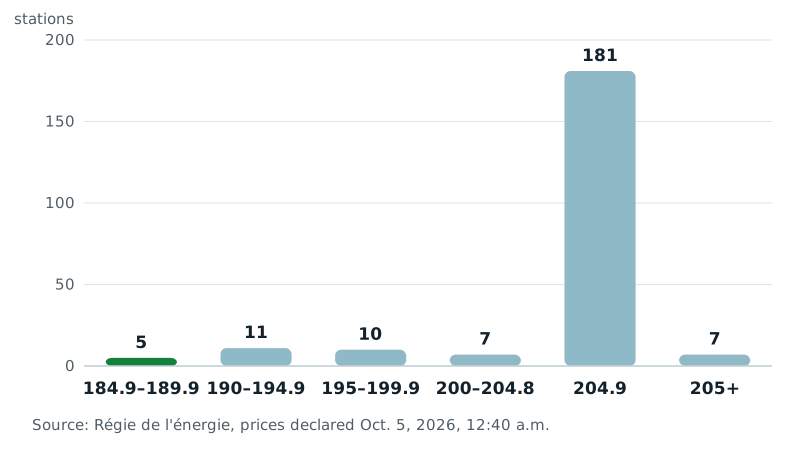
The first eleven tips cut the number of litres. This one works on the price of each litre, and two stations in the same neighbourhood can be further apart than you'd think. Quebec is where you can see it best, because every station there has had to declare its prices to the Régie de l'énergie, the provincial energy board, since April 1, 2026. On October 5, 2026, at 12:40 a.m., 181 of the 221 stations within 12 km of downtown Montreal had regular at 204.9¢/L. Five were selling it for 185.9¢/L or less. On a 50 L fill-up, a 19¢/L gap is $9.50.
Gazo shows the stations around you sorted from cheapest to most expensive. In Quebec, those are the official prices declared to the Régie, refreshed every 2 minutes, with the age of each price. In Ontario and the rest of Canada, they're prices reported by drivers or, when there's no recent report, the official estimate for the area (such as Ontario's weekly fuel price survey), always labelled as an estimate. No station pays to rank higher.
Before you head out, check the cheapest stations in Toronto, Calgary or Vancouver. Rewards cards can shave off a few more cents; we compare them in our guide to gas rewards programs in Canada. And if you'd like a heads-up when prices drop, price alerts come with Gazo+.
What won't help
Two expenses come up again and again and save you nothing. First, the plug-in "fuel savers" and other gadgets pushed in online ads: CAA-Quebec is blunt, no magnet or device will magically cut your fuel use.
Second, premium gas in a car designed for regular. According to CAA-Quebec, premium is only necessary if your car requires it; otherwise it's a waste of money. We explain why in Regular vs premium gas: which one does your car need?
Sources
Facts checked against these official or recognized sources.
- Natural Resources Canada, "Fuel-efficient driving techniques" (modified 2024-12-23): natural-resources.canada.ca (opens in a new tab) (accessed October 5, 2026)
- Natural Resources Canada, "Factors that affect fuel efficiency" (modified 2025-01-15): natural-resources.canada.ca (opens in a new tab) (accessed October 5, 2026)
- CAA National, "Fuel-Efficient Driving Tips": caa.ca (opens in a new tab) (accessed October 5, 2026)
- CAA-Quebec, "How to save on gas: 15 simple tips to follow" (updated August 21, 2025): caaquebec.com (opens in a new tab) (accessed October 5, 2026)
- City of Toronto, "Idling Control By-law": toronto.ca (opens in a new tab) and Toronto Municipal Code, Chapter 517, § 517-2: toronto.ca (opens in a new tab) (accessed October 5, 2026)
- Ville de Montréal, "Motor vehicle idling": montreal.ca (opens in a new tab) (accessed October 5, 2026)
- Régie de l'énergie, "Foire aux questions : pour les consommateurs" (in French; price platform live since April 1, 2026, declaration mandatory): regie-energie.qc.ca (opens in a new tab) (accessed October 5, 2026)
- Régie de l'énergie, prices declared by Quebec stations (public feed at regieessencequebec.ca), snapshot of October 5, 2026, 12:40 a.m. EDT recorded by Gazo: 221 stations within 12 km of downtown Montreal with a regular price available