Gas taxes in Canada and Quebec: how much you pay per litre
Federal excise tax, provincial gas tax, GST or HST: every litre of gas carries several taxes, and some are charged on top of the others. Here is what that adds up to in Montreal in October 2026, and how it compares across Canada.
 By The Gazo team
5 min read
By The Gazo team
5 min read
In this article
Early on Monday, October 5, the most common price for regular in Montreal was 204.9¢ a litre. Of that, 48.9¢ was tax, close to a quarter of the price. So how much tax is on gas in Canada? Here is each tax on a Quebec litre under the rules in effect on October 5, 2026, followed by the gas tax rates in every other province.
A litre of gas in Montreal, tax by tax
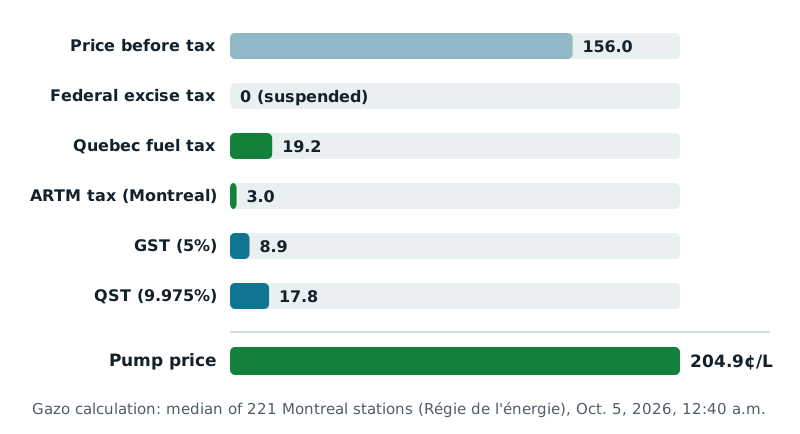
Here's the math, so you can check it:
- First remove GST and QST, which add up to 14.975%: 204.9 ÷ 1.14975 = 178.2¢.
- GST: 5% of 178.2 = 8.9¢. QST: 9.975% of 178.2 = 17.8¢.
- Then remove the fixed taxes: 19.2¢ for Quebec and 3.0¢ for the ARTM. The federal excise tax is at 0¢.
- That leaves 156.0¢: the price before tax, which covers the wholesale cost of gas, delivery and the station's margin.
On a 50-litre fill-up at that price ($102.45), taxes come to $24.45. The price before tax varies from station to station, which is why posted prices can differ so much in the same neighbourhood. The fixed taxes are the same for everyone in a given area. In Gazo, prices are the ones posted at the station, taxes included, sorted from cheapest to most expensive: the gap between two stations is their gap in price before tax, plus sales tax. In Quebec, these are the prices each station reports to the Régie de l'énergie, as explained in our article on Quebec's official station prices. You can't avoid the taxes, but you can buy less gas: here are 12 ways to use less gas.
The federal excise tax: suspended until January 31, 2027
Normally, Ottawa collects 10¢ on every litre of gas, a rate in place since 1995 according to Natural Resources Canada. The excise tax has been suspended since April 20, 2026. On September 2, the government announced it would stay suspended until January 31, 2027 (Bill C-38, introduced on September 22). After that:
- February 1 to March 31, 2027: 5¢ a litre, half the usual rate;
- from April 1, 2027: 10¢ a litre.
Because GST and QST also apply to the excise tax, each 5¢ step will add about 5.75¢ in Quebec (5¢ × 1.14975), or 5.65¢ with Ontario's 13% HST, if wholesale prices stay the same. According to Finance Canada, gas prices dropped 11¢ a litre on the day the suspension began.
Quebec's fuel tax and the ARTM tax
Quebec's tax on gasoline has been 19.2¢ a litre since April 1, 2013, under the province's Fuel Tax Act. It changes with location:
- +3¢ in the territory of the Autorité régionale de transport métropolitain (ARTM), the Montreal region. The revenue goes to public transit, the Régie de l'énergie notes.
- +1¢ in Gaspésie–Îles-de-la-Madeleine.
- −4.65¢ in the outlying regions listed by regulation, including Abitibi, Saguenay–Lac-Saint-Jean, the North Shore and Gaspésie, and −2.3¢ in certain "specific regions".
- Near the borders, the cut depends on distance: 2¢ to 8¢ near Ontario or New Brunswick, 3¢ to 12¢ near the United States, with the biggest cut within 5 km.
That's one reason gas doesn't cost the same everywhere in Quebec: compare gas prices in Montreal and in Gatineau, for example. The other reasons, like delivery from the terminals and competition between stations, are covered in our article on why gas prices change.
GST and QST: taxes charged on taxes
Is GST charged on gas? Yes, and on the whole price: the 5% GST applies on top of the excise tax and the provincial fuel tax, as Natural Resources Canada and the Régie de l'énergie confirm. The 9.975% QST also applies to the other taxes, according to the Régie, but not to GST: Quebec's sales tax law leaves GST out of its base.
The result: in Montreal, the 22.2¢ of fixed taxes actually cost 25.5¢, because GST and QST add 3.3¢ on top (22.2 × 0.14975).
What about the carbon tax?
For drivers, there isn't one at the pump anymore, in any province or territory.
- The federal fuel charge ended on April 1, 2025, according to the Canada Revenue Agency. It never applied in Quebec, which has its own system.
- British Columbia's carbon tax was eliminated on the same date.
- Quebec has a carbon market (the cap-and-trade system known as SPEDE), linked with California's. It isn't a tax you see: the cost of emission allowances is passed on in fuel prices and is already part of the price before tax. Quebec's environment ministry estimates it at 8.4¢ a litre of gas at a price of $40 per emission unit.
How much tax is on gas in Canada, province by province
Rates per litre of gas in effect on October 5, 2026, checked on official provincial and regulator websites (federal excise tax suspended everywhere):
| Province | Provincial gas tax | Sales tax | Good to know |
|---|---|---|---|
| Quebec | 19.2¢ | GST 5% + QST 9.975% | +3¢ in the Montreal region |
| Ontario | 9.0¢ | HST 13% | Permanent rate since July 2025 |
| British Columbia | 14.5¢ | GST 5% | 20.0¢ (Victoria area), 27.0¢ (Vancouver area) |
| Alberta | 0¢ | GST 5% | 13¢ tax suspended since October 1, 2026 |
| Saskatchewan | 15.0¢ | GST 5% | No provincial sales tax on gas |
| Manitoba | 12.5¢ | GST 5% | Since January 1, 2025 |
| New Brunswick | 10.87¢ | HST 15% | Regulated maximum price |
| Nova Scotia | 15.5¢ | HST 14% | HST cut on April 1, 2025 |
| Prince Edward Island | 0¢ | HST 15% | 8.47¢ tax suspended until January 31, 2027 |
| Newfoundland and Labrador | 7.5¢ | HST 15% | Reduced rate made permanent in 2026 |
A few details. In Alberta, the 13¢ tax depends on the price of WTI crude: it drops to zero when the average reaches US$90 a barrel or more, and the current suspension will last at least until December 31, 2026. In British Columbia, the Vancouver-area and Victoria-area rates include a tax for public transit. According to Natural Resources Canada, Vancouver, Victoria and Montreal are the only three cities in the country where a local tax is added this way. In Atlantic Canada, the tax is already built into the maximum price set by the regulator. To see station prices province by province: Ontario, Alberta, British Columbia.
Sources
Facts checked against these official or recognized sources.
- Régie de l'énergie, prices reported by stations (regieessencequebec.ca), logged by Gazo: 221 stations within 12 km of downtown Montreal, October 5, 2026 at 12:40 a.m.
- Régie de l'énergie, "Foire aux questions : Le prix de l'essence, du diesel et du mazout léger" (in French): regie-energie.qc.ca (opens in a new tab) (accessed October 5, 2026)
- Department of Finance Canada, "The Government of Canada extends the federal fuel excise tax relief on gasoline, diesel, and aviation fuels for Canadians", September 2, 2026: canada.ca (opens in a new tab) (accessed October 5, 2026)
- Department of Finance Canada, "Minister Champagne introduces legislation to extend the federal fuel excise tax relief for Canadians" (Bill C-38), September 22, 2026: canada.ca (opens in a new tab) (accessed October 5, 2026)
- Natural Resources Canada, "Fuel Consumption Levies in Canada" (rates last updated September 2, 2026): natural-resources.canada.ca (opens in a new tab) (accessed October 5, 2026)
- Canada Revenue Agency, "FCN16 Removal of the fuel charge": canada.ca (opens in a new tab) (accessed October 5, 2026)
- LégisQuébec, Fuel Tax Act (chapter T-1), section 2 (in French): legisquebec.gouv.qc.ca (opens in a new tab) (accessed October 5, 2026)
- LégisQuébec, Regulation respecting the application of the Fuel Tax Act (chapter T-1, r. 1), sections 2R1 to 2R4 (in French): legisquebec.gouv.qc.ca (opens in a new tab) (accessed October 5, 2026)
- LégisQuébec, Act respecting the Québec sales tax (chapter T-0.1), sections 16 and 52 (in French): legisquebec.gouv.qc.ca (opens in a new tab) (accessed October 5, 2026)
- Quebec Ministry of the Environment, "The Carbon Market, a Green Economy Growth Tool!": environnement.gouv.qc.ca (opens in a new tab) (accessed October 5, 2026)
- Government of Ontario, "Gasoline tax": ontario.ca (opens in a new tab) (accessed October 5, 2026)
- Government of British Columbia, "Motor fuel tax and carbon tax rates on fuels and substances": www2.gov.bc.ca (opens in a new tab) (accessed October 5, 2026)
- Government of Alberta, "Fuel tax – Fuel sellers" and "Tax, levy, and prescribed interest rates": alberta.ca (opens in a new tab) and alberta.ca (opens in a new tab) (accessed October 5, 2026)
- Government of Saskatchewan, "Fuel Tax": sets.saskatchewan.ca (opens in a new tab) (accessed October 5, 2026)
- Government of Manitoba, "Fuel Tax": gov.mb.ca (opens in a new tab) (accessed October 5, 2026)
- Government of New Brunswick, "Gasoline, Motive Fuel and Carbon Emitting Product Tax": www2.gnb.ca (opens in a new tab) (accessed October 5, 2026)
- Government of Nova Scotia, "Fuel Tax" program overview: novascotia.ca (opens in a new tab) (accessed October 5, 2026)
- Government of the Northwest Territories, "Carbon Pricing in the Northwest Territories": fin.gov.nt.ca (opens in a new tab) (accessed October 5, 2026)
- Island Regulatory and Appeals Commission, notice of September 25, 2026 on the provincial tax suspension: irac.pe.ca (opens in a new tab) (accessed October 5, 2026)
- Government of Newfoundland and Labrador, "A Plan for Lower Taxes – Budget 2026": gov.nl.ca (opens in a new tab) (accessed October 5, 2026)
- Canada Revenue Agency, "GST/HST calculator (and rates)" and "Charge and collect the GST/HST": canada.ca (opens in a new tab) and canada.ca (opens in a new tab) (accessed October 5, 2026)
- Government of British Columbia, "Motor fuel tax and carbon tax frequently asked questions" (GST on fuel taxes): www2.gov.bc.ca (opens in a new tab) (accessed October 5, 2026)