Why is gas more expensive in Quebec than in Ontario?
Over 52 weeks, regular averaged 172.4¢/L in Montreal and 156.2¢/L in Toronto. We split those prices, and the prices in nine other Canadian cities, into three pieces: taxes, the wholesale price and the station's margin.
 By The Gazo team
6 min read
By The Gazo team
6 min read
In this article
You notice it the moment you cross the bridge from Ottawa to Gatineau, or fill up in Montreal after leaving Toronto. So why is gas more expensive in Quebec than in Ontario? To answer with numbers instead of hunches, we took Natural Resources Canada's (NRCan) weekly averages over 52 weeks, from October 1, 2025 to September 29, 2026. NRCan splits every price into pieces, so you can see where each cent goes.
Gas prices by province: three pieces to compare
In NRCan's retail price tables by city (opens in a new tab), a litre of regular breaks down into three main parts:
- Taxes: the federal excise tax (suspended since April 20, 2026), the provincial tax, a regional tax in Montreal, Vancouver and Victoria, then GST or HST, plus QST in Quebec.
- The wholesale price, also called the rack price: the cost of crude oil plus the refiner's margin.
- The retail margin: the gap between the pump price before tax and the wholesale price. It pays for delivery to the station, running it, and its profit.
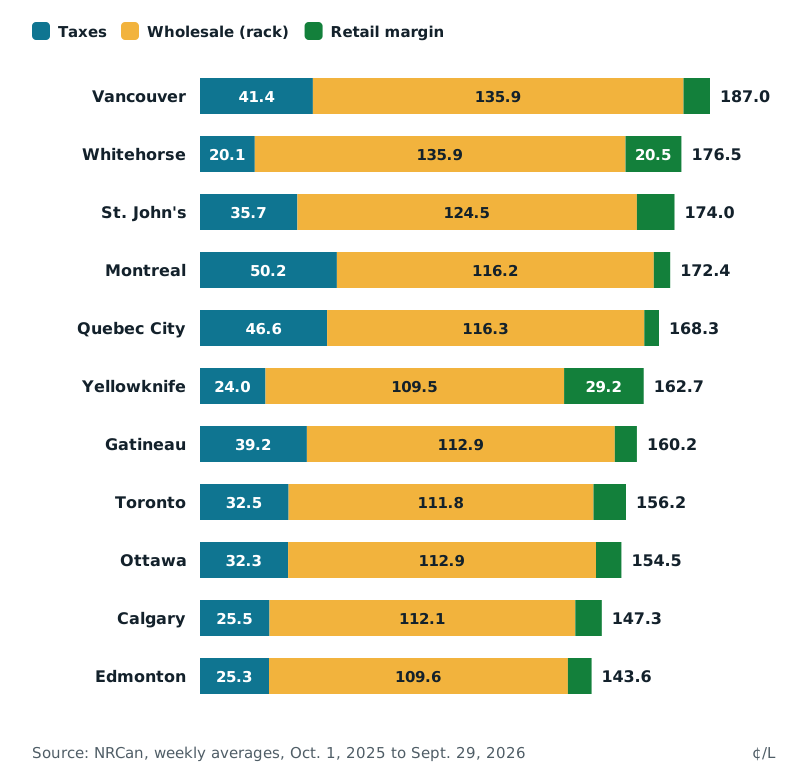
Over that period, NRCan's Canadian average was 162.0¢/L. Of the 71 cities it tracks, Vancouver came out on top (187.0¢/L) and Lloydminster, Alberta, came in last (143.4¢/L). That's a 43.6¢ gap, or $21.80 on a 50-litre fill-up.
Why is gas more expensive in Quebec than Ontario?
In Montreal, regular averaged 172.4¢/L, compared with 156.2¢/L in Toronto: 16.2¢ more. Taxes alone account for a 17.7¢ gap (50.2¢ vs 32.5¢). The wholesale price was slightly higher in Montreal (4.4¢ more), but its retail margin was the thinnest on the chart along with Quebec City's: 6.0¢ in Montreal and 5.4¢ in Quebec City, compared with 11.9¢ in Toronto. In other words, before tax, gas cost 1.5¢ less in Montreal than in Toronto.
Why so much tax? Quebec collects 19.2¢ a litre, plus 3¢ in the Montreal area for public transit, while Ontario collects 9.0¢. Then QST is added on top of GST (14.975% in all, vs 13% HST in Ontario), and it's calculated on a price that already includes the fixed taxes. Quebec also has a carbon market, whose cost doesn't show up as a tax: it's built into the price before tax. For the tax-by-tax breakdown, see our guide to gas taxes in Canada and Quebec.
What about Quebec City? 168.3¢/L on average, 4.1¢ less than Montreal. The main reason: no ARTM transit tax, so 46.6¢ of taxes instead of 50.2¢.
Gatineau vs Ottawa: the gap shrinks near the border
Near Ontario, Quebec lowers its fuel tax, by 2¢ to 8¢ depending on the distance. The result: 160.2¢/L on average in Gatineau vs 154.5¢/L in Ottawa, a 5.7¢ gap. The wholesale price is the same on both sides (112.9¢); taxes make the difference (39.2¢ vs 32.3¢).
On a 50-litre fill-up, that's $2.85. Crossing the river just for that only makes sense if you're going anyway. Instead, compare current station prices on our pages for gas prices in Ottawa and in Gatineau.
Why is gas so expensive in BC?
Vancouver paid the highest gas prices of all 71 cities: 187.0¢/L on average, 39.7¢ more than Calgary (147.3¢/L). Here, taxes explain only 15.9¢ of the gap (41.4¢ vs 25.5¢), even with the Vancouver-area transit tax. The big piece is the wholesale price: 135.9¢ in Vancouver vs 112.1¢ in Calgary, 23.8¢ more.
B.C. relies on supply from far away. According to the Canada Energy Regulator's energy profile of British Columbia (opens in a new tab), most of the gasoline used in the province comes from Alberta, mainly through the Trans Mountain pipeline. B.C. has only two refineries, in Burnaby (55,000 barrels a day) and Prince George (12,000), and it also imports gasoline by ship or barge from the U.S. Pacific Northwest.
In 2019, the British Columbia Utilities Commission's inquiry (opens in a new tab) also found an unexplained difference of about 13¢ a litre in wholesale prices in southern B.C., in a wholesale market it described as not truly competitive.
The territories are their own story. Whitehorse pays the same wholesale price as Vancouver (135.9¢) but little tax (20.1¢), while Yellowknife has the biggest retail margin on the chart (29.2¢). Back in 2017, a Canada Energy Regulator market snapshot (opens in a new tab) already put those higher margins down to the remoteness of northern communities.
Why is gas cheaper in Alberta?
Edmonton (143.6¢/L) and Calgary (147.3¢/L) are among the cheapest cities in the country. Three reasons stand out in the numbers:
- Crude costs less in the West. In NRCan's tables, what's left once taxes and both margins are removed is the cost of crude: 65.0¢ on average in the West, vs 74.8¢ in Quebec and Atlantic Canada.
- The refineries are right there. Alberta has five, and the largest refining capacity in the country (569,000 barrels a day), according to the Canada Energy Regulator.
- Taxes are low. 25.3¢ in Edmonton, half of Montreal's. And the 13¢ provincial fuel tax, which depends on oil prices, has been suspended since October 1, 2026, until at least December 31.
Station prices, city by city, are on our page for gas prices in Alberta.
Atlantic Canada: prices set by a regulator
In all four Atlantic provinces, a board or commission sets a maximum gas price, and sometimes a minimum one, as the Canada Energy Regulator's snapshot on Atlantic price regulation (opens in a new tab) sums up. A regulated price isn't necessarily a low one: Halifax (162.0¢/L) and Moncton (163.2¢/L) sit close to the Canadian average, but St. John's (174.0¢/L) is even above Montreal. In St. John's, both the wholesale price (124.5¢ vs 109.7¢ in Halifax) and the retail margin (13.8¢ vs 11.4¢) are higher.
What these gaps mean for your fill-up
The gap between provinces is out of your hands: nobody escapes their province's tax. What you can work with is the gap between stations in your own city. NRCan lists four factors behind price differences from one neighbourhood to the next: taxes, competition, the volume a station sells and its location.
In practice:
- Compare before you fill up: in Toronto as in Montreal, stations in the same area aren't at the same price.
- Driving to Quebec, or the other way? Our guide to road trip gas cost in Canada shows the math and where to stop.
- In Quebec, prices move in waves: here's what to do when gas prices are going up.
Sources
Facts checked against these official or recognized sources.
- Natural Resources Canada, "Average Retail Prices for Regular Gasoline" by city (price, taxes, marketing margin and refining margin, weekly averages for 2025 and 2026): www2.nrcan-rncan.gc.ca (opens in a new tab) (accessed October 6, 2026)
- Gazo, 52-week averages (October 1, 2025 to September 29, 2026) of NRCan's weekly prices for 71 cities and the Canadian average; wholesale price = price − taxes − retail margin; Gazo calculations (internal data)
- Canada Energy Regulator, "Provincial and Territorial Energy Profiles – British Columbia": cer-rec.gc.ca (opens in a new tab) (accessed October 6, 2026)
- Canada Energy Regulator, "Provincial and Territorial Energy Profiles – Alberta": cer-rec.gc.ca (opens in a new tab) (accessed October 6, 2026)
- British Columbia Utilities Commission, "Inquiry into Gasoline and Diesel Prices in British Columbia – Final Report," August 30, 2019: ordersdecisions.bcuc.com (opens in a new tab) (accessed October 6, 2026)
- Canada Energy Regulator, "Market Snapshot: Why do gasoline prices differ across Canada?", September 13, 2017: cer-rec.gc.ca (opens in a new tab) (accessed October 6, 2026)
- Canada Energy Regulator, "Market Snapshot: Understanding the Regulation of Gasoline Prices in Atlantic Canada," May 30, 2017: cer-rec.gc.ca (opens in a new tab) (accessed October 6, 2026)
- Natural Resources Canada, "Why Gasoline Prices Vary Across Canada": natural-resources.canada.ca (opens in a new tab) (accessed October 6, 2026)
- LégisQuébec, Fuel Tax Act (chapter T-1): legisquebec.gouv.qc.ca (opens in a new tab) (accessed October 6, 2026)
- Government of Ontario, "Gasoline tax": ontario.ca (opens in a new tab) (accessed October 6, 2026)
- Government of Alberta, "Fuel tax – Fuel sellers" (tax suspended since October 1, 2026): alberta.ca (opens in a new tab) (accessed October 6, 2026)