
Regular vs premium gas: which one does your car need?
Premium costs roughly 26 to 30 cents a litre more than regular right now in Quebec and Ontario. Before you pay that, check your owner's manual: the answer often comes down to one word, required or recommended.
 By The Gazo team
5 min read
By The Gazo team
5 min read
In this article
Choosing between regular vs premium gas deserves more than habit or a hunch that premium is "better for the engine." To get it right, you need to know what the number on the pump measures, read the right line in your manual, then run the numbers.
What the octane number on the pump means
Octane rating measures how well gas resists knocking, also called pinging: fuel that ignites too early in the engine. It's not a measure of quality, cleanliness or energy.
In Canada, the number on the pump is the average of two lab measurements, the research octane number and the motor octane number. According to the terminology database of Quebec's French-language office (OQLF), regular is about 87 (the average of 91 and 82) and premium about 91 (the average of 95 and 85). That's the whole story behind 87 vs 91 octane. Mid-grade sits in between.
A travel tip: Europe's Eurosuper, sold as "95," has a research octane number of at least 95 and a motor octane number of at least 85. In other words, it's roughly our 91 premium, labelled differently.
In Quebec, the Petroleum Products Regulation requires gasoline to meet the national standard CAN/CGSB-3.5 "Automotive gasoline," or CAN/CGSB-3.511 when it contains ethanol.
Premium required vs recommended: what your manual says
Open your owner's manual to the fuel section. You'll land on one of three cases, and the right answer is different for each.
Your manual says regular
Most gasoline vehicles are designed to run on 87 octane, says fueleconomy.gov, run by the U.S. Department of Energy and Environmental Protection Agency. Under normal driving conditions, higher octane gives little to no benefit. CAA-Quebec puts it more bluntly: premium is only necessary if your car requires it; otherwise it's a waste of money.
Your manual says premium recommended
The engine runs on regular, but the manufacturer says it does a little better on premium. It's your call. According to fueleconomy.gov, the cost increase is typically higher than the fuel savings.
Your manual says premium required
No debate here. Using a lower octane than required can make the engine run poorly, damage the engine and emissions control system over time, and may void your warranty.
These are often high-compression, turbocharged or supercharged engines. They squeeze the air/fuel mixture harder to get more energy out of it, which takes fuel that better resists igniting early. So, turbo engine, regular or premium? There's no general rule: the manual for your model decides.
Engine knocking: the sound to listen for
In older vehicles, gas that's too low in octane for the engine can be heard: a knocking or pinging sound. Many newer engines adjust the spark timing to reduce knock, but power and fuel economy still suffer, fueleconomy.gov notes.
In other words, silence doesn't prove regular is fine in an engine that requires premium. And if your car knocks on the fuel your manual recommends, have it checked.
What premium won't do
It won't make a car designed for regular more powerful or more fuel-efficient. The only possible gain, per fueleconomy.gov, is slight and limited to severe duty: towing, heavy loads, especially in hot weather.
It isn't automatically "cleaner" either. What keeps an engine clean is detergent additives. TOP TIER, a fuel performance standard set by automakers, requires licensed fuel marketers to use approved additives in all grades of gasoline they sell, regular included, at no added cost at the pump. The list of approved brands is on the program's website, toptiergas.com.
Finally, the best time to think about this is before you buy. NRCan gives the example of a compact car offered with a standard engine (6.4 L/100 km) or a "sport" version (8.4 L/100 km) that requires premium. Over 200,000 km, the sport version could cost $6,520 more in fuel, assuming a gap of just 15 cents between regular and premium.
The regular vs premium gas price difference right now
In Ontario's weekly fuel price survey for the week of September 28, 2026, regular averaged 179.8¢/L across the province, mid-grade 200.8¢/L and premium 210.1¢/L: a 30.3¢ gap between regular and premium.
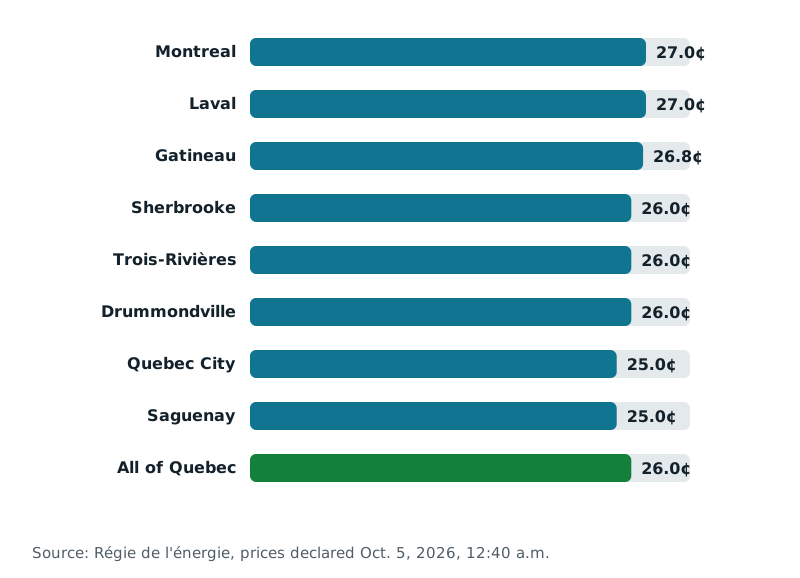
Quebec is the one province where every station must declare its prices, so the gap can be measured station by station. On October 5, 2026, at 12:40 a.m., among the 2,417 Quebec stations declaring both a regular and a premium price to the Régie de l'énergie, the median gap was 26.0¢/L. Half the stations were between 25 and 27 cents, and the difference from one big city to the next is small.
On a fill-up and over a year
On a 50 L fill-up, a 30.3¢/L gap is $15.15 in Ontario; at 26¢/L in Quebec, it's $13.00.
For a year, let's use NRCan's assumptions. Its 2026 Fuel Consumption Guide works out annual costs over 20,000 km. With the "sport" compact from its example, at 8.4 L/100 km, that's 1,680 L a year. Premium then costs $509.04 more per year than regular at Ontario's gap, or $436.80 at Quebec's.
If your manual requires premium, that amount is part of what the car costs you. If it only recommends premium, that's the number to weigh against the small gain on offer.
How to pay less for premium
The gap doesn't just depend on the city: it changes from one station to the next. On October 5, 2,357 of the 2,417 Quebec stations had a gap of 20 to 30 cents a litre, but 41 were above 30 cents.
So if your car requires premium, compare premium prices, not regular ones. In Gazo, pick "Premium": nearby stations are sorted by that price. In Quebec they're the official prices declared to the Régie; elsewhere, prices reported by drivers or a clearly labelled official estimate.
The Toronto, Ottawa and Montreal pages give you a snapshot of prices right now. To trim the rest of your fuel bill, see our 12 ways to use less gas, and how much of each litre goes to gas taxes in Canada and Quebec.
Sources
Facts checked against these official or recognized sources.
- Office québécois de la langue française, Grand dictionnaire terminologique, entries "essence ordinaire," "supercarburant" and "eurosuper" (in French): vitrinelinguistique.oqlf.gouv.qc.ca (opens in a new tab), vitrinelinguistique.oqlf.gouv.qc.ca (opens in a new tab), vitrinelinguistique.oqlf.gouv.qc.ca (opens in a new tab) (accessed October 5, 2026)
- LégisQuébec, "Petroleum Products Regulation," CQLR c. P-30.01, r. 2, s. 2 and 3 (up to date as of June 1, 2026): legisquebec.gouv.qc.ca (opens in a new tab) (accessed October 5, 2026)
- U.S. Department of Energy and U.S. Environmental Protection Agency, fueleconomy.gov, "Selecting the Right Octane Fuel": fueleconomy.gov (opens in a new tab) (accessed October 5, 2026)
- CAA-Quebec, "How to save on gas: 15 simple tips to follow" (updated August 21, 2025), tip 3: caaquebec.com (opens in a new tab) (accessed October 5, 2026)
- TOP TIER, program home page and "Consumer FAQs" ("Is TOP TIER only for premium gasoline or diesel?"): toptiergas.com (opens in a new tab) and toptiergas.com (opens in a new tab) (accessed October 5, 2026)
- Natural Resources Canada, "Factors that affect fuel efficiency," horsepower section (modified 2025-01-15): natural-resources.canada.ca (opens in a new tab) (accessed October 5, 2026)
- Natural Resources Canada, "2026 Fuel Consumption Guide" (annual cost based on 20,000 km): natural-resources.canada.ca (opens in a new tab) (accessed October 5, 2026)
- Government of Ontario, "Fuels price survey information," week of September 28, 2026, Ontario average: data.ontario.ca (opens in a new tab) (file ontario.ca (opens in a new tab), accessed October 5, 2026)
- Régie de l'énergie, prices declared by Quebec stations (public feed at regieessencequebec.ca), snapshot of October 5, 2026, 12:40 a.m. EDT recorded by Gazo: 2,417 stations with both a regular and a premium price available; city medians calculated by Gazo within 12 km of each city centre (15 km for Saguenay)