
Electric vs gas car cost in Canada: a full year, side by side
Over 20,000 km in Quebec, gas for a Hyundai Kona cost about $2,508 over the 12 months from September 2025 to August 2026. Electricity for the electric version: $464 to $633. Here's the full calculation, and what it leaves out.
 By The Gazo team
5 min read
By The Gazo team
5 min read
In this article
Comparing an electric car and a gas car per 100 km is a good start. But what matters for your budget is a full year, with all the ups and downs of gas prices. So we reran the electric vs gas car cost comparison over 12 months, with official prices and the public rates in effect on October 6, 2026. Our numbers are for Quebec, with gas costs for other cities on the chart.
Electric vs gas car cost: how we did it
We compare two versions of the same model, the 2026 Hyundai Kona, so we're not pitting a compact against an SUV. According to NRCan's fuel consumption ratings (opens in a new tab), the 2.0 L front-wheel-drive gas Kona uses 7.6 L per 100 km combined, and the Kona Electric uses 18.1 kWh per 100 km.
Distance: 20,000 km a year, the figure the Quebec government uses for its own charging cost estimates. That's 1,520 litres of gas on one side and 3,620 kWh of electricity on the other.
What gas costs over 12 months
For the price, we used the Régie de l'énergie's official monthly averages for all of Quebec, from September 2025 to August 2026. The 12-month average: 165.0¢/L. Over 20,000 km, gas for the Kona comes to about $2,508.
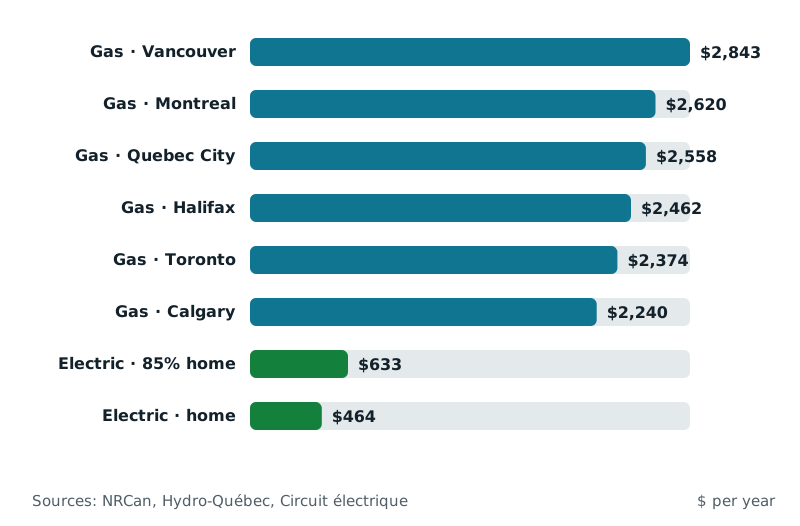
Except that the year was anything but steady. In January 2026, a litre averaged 141.5¢; in May, 193.9¢. At January's price, those 1,520 litres would have cost $2,151; at May's, $2,947. Close to an $800 swing for the same car and the same distance, depending on the time of year. Where you live matters too: as the chart shows, your city can add hundreds of dollars.
What electricity costs: $464 to $633
At home, charging is generally billed at the second-tier price of Rate D, or 12.813¢/kWh with taxes at the April 1, 2026 rate, according to Hydro-Québec's savings calculator (opens in a new tab). For 3,620 kWh, that's $463.83 a year if every charge happens at home.
Nobody charges only at home. With 15% of charging at a 100 kW fast charger, at the $0.44/kWh listed in the Circuit électrique's rates (opens in a new tab), the bill rises to $633. The Quebec government lands in the same range on its charging locations and costs page (opens in a new tab): $300 to $400 more a year on the electricity bill for 20,000 km with 85% of charging at home, and about $650 a year without a home charger.
Energy alone, the Kona Electric saves $1,875 to $2,044 a year at the average prices of the past 12 months. Outside Quebec, swap in your own utility rate: the formula is the same. To find chargers, the EV charging map covers all of Canada, and our guide to free EV charging stations shows where they are.
Electric vs gas car maintenance
Hydro-Québec lists what goes away with an EV: no oil changes, and no oil filters, spark plugs, timing belt or exhaust. Regenerative braking puts less wear on the discs and pads, which can last two to three times longer. A plug-in hybrid still needs oil changes, just less often.
We don't put a dollar figure on maintenance: it depends on the model, the dealer and how you drive, and we found no official source that puts a number on it for 2026. Tires, insurance and registration also vary from one vehicle to the next.
EV rebates in 2026, and fees ahead
The purchase price is still the big difference. Two programs narrow the gap in 2026:
- Federal, Electric Vehicle Affordability Program: up to $5,000 in 2026 for a battery-electric vehicle bought or leased since February 16, 2026, if the final transaction value is $50,000 or less (no cap for vehicles made in Canada), according to Transport Canada's program overview (opens in a new tab). The maximum drops gradually: $4,000 in 2027, then $2,000 in 2030 and 2031.
- Quebec, Roulez vert program: up to $2,000 for a new fully electric vehicle registered in 2026, and the program ends on December 31, 2026. Only the registration date counts.
As for fees, Quebec's 2025-2026 budget announced an annual contribution for electric and plug-in hybrid vehicles starting January 1, 2027, and the end of free toll bridges and ferries for green plates on April 1, 2027.
Are electric cars worth it in Canada? The break-even math
To see whether an EV pays off for you, divide the purchase price gap, after rebates, by the yearly savings. Example: if the EV costs $8,000 more once rebates are deducted, and you save $2,000 a year on energy, it takes about four years to make up the difference. At 10,000 km a year, the savings are cut in half and it takes eight.
Three things tip the scale:
- How much you drive. The more you drive, the faster an EV earns back its price.
- Charging at home. Without a home charger, the savings shrink, as the Quebec government's estimate shows.
- The price of gas. Charging at home, the yearly savings drop to about $1,690 at 141.5¢/L, as in January 2026, and reach about $2,480 at 193.9¢/L, as in May.
Keeping your gas car for now? Cut the bill by comparing gas prices in Toronto or Quebec, and with our 12 ways to use less gas. Before a long drive, work out your road trip gas cost, and see why gas is more expensive in Quebec than in Ontario.
Sources
Facts checked against these official or recognized sources.
- Natural Resources Canada, "Fuel consumption ratings," 2026 vehicles and 2012-2026 battery-electric vehicles (Hyundai Kona 2.0 L and Kona Electric): open.canada.ca (opens in a new tab) (accessed October 6, 2026)
- Régie de l'énergie, "Produits pétroliers," average posted price of regular by administrative region, weighted monthly averages for Quebec, 2025 and 2026 (CSV, in French): regie-energie.qc.ca (opens in a new tab) (accessed October 6, 2026)
- Natural Resources Canada, weekly averages for regular by city, October 1, 2025 to September 29, 2026 (data read by Gazo): www2.nrcan-rncan.gc.ca (opens in a new tab) (accessed October 6, 2026)
- Hydro-Québec, "Drive electric and save: Do the math!" (12.813¢/kWh with taxes, maintenance): hydroquebec.com (opens in a new tab) (accessed October 6, 2026)
- Circuit électrique, "Rates" (100 kW fast charger: $0.44/kWh from 50 to 100 kW): lecircuitelectrique.com (opens in a new tab) (accessed October 6, 2026)
- Government of Quebec, "Electric vehicle charging locations and estimated costs": quebec.ca (opens in a new tab) (accessed October 6, 2026)
- Government of Quebec, "About the Roulez vert Program" (2026 amounts, ends December 31, 2026): quebec.ca (opens in a new tab) (accessed October 6, 2026)
- Transport Canada, "Electric Vehicle Affordability Program: Overview": tc.canada.ca (opens in a new tab) (accessed October 6, 2026)
- Government of Quebec, "Budget 2025-2026 – Communiqué no 3 de 3 – Améliorer le régime fiscal" (in French): quebec.ca (opens in a new tab) (accessed October 6, 2026)