
EV charging cost in Canada: home, public chargers and gas compared
We took the rates in effect on October 5, 2026 (Hydro-Québec, the Ontario Energy Board, BC Hydro, the Circuit électrique network) and the official rating of a Hyundai Kona to work out what 100 km costs at home, at a public charger and at the pump.
 By The Gazo team
7 min read
By The Gazo team
7 min read
In this article
EV charging cost in Canada depends first on where you plug in. At home, you pay your utility's price for electricity. At a public charger, you pay the network's or the owner's rate: by the hour, by the session or by the kilowatt-hour (kWh). To compare apples to apples, we ran every calculation with the same car and the rates in effect on October 5, 2026.
Our reference car: the Hyundai Kona
We picked the Kona because it comes in both electric and gas versions. According to Natural Resources Canada's (NRCan) 2026 fuel consumption ratings (opens in a new tab), the Kona Electric uses 18.1 kWh per 100 km combined (55% city, 45% highway). The 2.0 L gas Kona, front-wheel drive with a continuously variable transmission, uses 7.6 L of regular per 100 km.
These are official ratings, measured the same way for every model. For other popular 2026 EVs, NRCan lists 19.3 kWh/100 km for the front-wheel-drive Chevrolet Equinox EV and 15.3 kWh/100 km for the rear-wheel-drive Tesla Model 3 Premium: redo the math with your own car's rating.
Charging at home: what your electricity costs
Hydro-Québec notes that home and work usually cover 90% of an EV's charging needs. That makes your residential rate the biggest factor in your budget.
Quebec: Hydro-Québec's Rate D
Since April 1, 2026, Hydro-Québec's Rate D (opens in a new tab) has two prices: 7.065¢/kWh for the first tier (40 kWh per day of the billing period) and 11.142¢/kWh for the rest, before taxes. Hydro-Québec says EV charging generally falls into the second tier, which works out to 12.813¢/kWh with taxes.
The math for a Kona Electric: 18.1 kWh × 12.813¢ = $2.32 per 100 km. A 30 kWh charge at home comes to about $3.84. The Quebec government, for its part, estimates $300 to $400 more per year on the electricity bill for 20,000 km, if 85% of charging is done at home.
Ontario: Ontario Energy Board prices
The Ontario Energy Board (opens in a new tab) (OEB) sets its prices once a year, on November 1. The November 1, 2025 prices are still in effect: 3.9¢/kWh every day from 11 p.m. to 7 a.m. on the Ultra-Low Overnight plan, 9.8¢/kWh off-peak on Time-of-Use, or 12.0¢ then 14.2¢/kWh on the Tiered plan.
Heads up: these prices only cover the "Electricity" line of your bill; delivery and HST come on top. At 3.9¢/kWh, the electricity alone for a Kona Electric is 71¢ per 100 km, but your total bill will be higher. Check the prices again after November 1.
British Columbia: BC Hydro
Since April 1, 2026, BC Hydro charges 11.87¢/kWh for the first 675 kWh a month, then 14.08¢/kWh on the tiered rate, or 12.70¢/kWh on the flat rate, before taxes. BC Hydro's time-of-day option (opens in a new tab), in effect since July 1, 2026, takes 5¢/kWh off overnight (11 p.m. to 7 a.m.) and adds 5¢ from 4 to 9 p.m. It can apply to a dedicated EV charger meter only.
For a Kona Electric on Step 2, that's $2.55 per 100 km; overnight with time-of-day pricing, $1.64, before taxes.
Public chargers: by the hour or by the kWh
According to NRCan, time-based and flat-fee billing are the most common in Canada, and Measurement Canada is developing requirements to allow per-kWh billing at public chargers. That's why the same charge can cost very different amounts from one charger to the next.
Circuit électrique Level 2
Level 2 rates are set by charger owners, within a grid set by Quebec's Circuit électrique network (opens in a new tab): $0 to $20 per session, or $0.25 to $3 an hour billed by the second, taxes included. An idle fee ($0 to $3 an hour) can apply when the car stays plugged in after charging.
In Gazo's database, 2,399 of the network's Level 2 chargers publish an hourly rate: 1,184 charge $1.00 an hour and 80% charge $1.10 or less. At $1.10 an hour, if the car draws 7.2 kW, the 18.1 kWh needed for 100 km take about 2.5 hours and cost $2.77. Since you pay for time, a car that charges more slowly pays more per kWh.
Circuit électrique DC fast charging
At fast chargers, the rate depends on the power delivered, taxes included. On a 50 kW charger, it's $0.38/kWh between 20 and 50 kW. On a 100 kW charger, $0.49/kWh between 20 and 50 kW and $0.44/kWh between 50 and 100 kW. On chargers of 120 kW and up, $0.44 to $0.62/kWh depending on power. Below 20 kW, you pay by the hour instead ($13.80 to $19.22 an hour), and that hourly rate doubles past 90% charge.
For 100 km, a Kona Electric pays from $6.88 (at $0.38/kWh) to $11.22 (at $0.62/kWh), and $7.96 at $0.44/kWh. The Circuit électrique even recommends unplugging at 80% on its fast chargers, for speed and price. These rates are indexed at the start of each year.
Elsewhere in Canada
BC Hydro has published the prices at its public chargers since April 1, 2026: $0.3083/kWh for Level 2 and $0.3969/kWh for fast charging, before taxes, plus $0.40 a minute in idle fees at fast chargers. For a Kona Electric, that's $5.58 and $7.18 per 100 km. At Electrify Canada, the price depends on the location and your plan and shows in the app; at FLO, it's set by the site host. The Quebec government puts public Level 2 charging at $0 to $5 an hour, and a fast charge at $15 to $30.
Electricity vs gas: 100 km side by side
For gas, we used the median price of regular declared to the Régie de l'énergie by 2,446 Quebec gas stations on October 5, 2026: 192.9¢/L. At 7.6 L/100 km, the gas Kona costs $14.66 per 100 km. In Toronto, using NRCan's daily average for October 2, 2026 (185.7¢/L), it's $14.11.
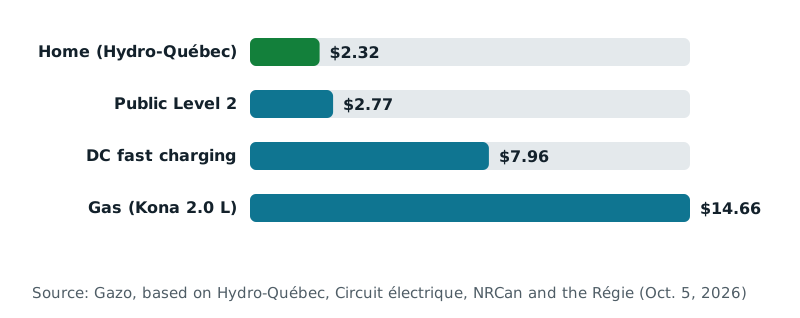
Charged at home in Quebec, the Kona Electric costs a little over six times less per 100 km than the gas Kona. Even at the Circuit électrique's highest fast-charging rate ($11.22), it stays below the $14.66 for gas. NRCan lands in the same ballpark in its 2026 Fuel Consumption Guide (opens in a new tab), using its own assumptions (20,000 km, $1.50/L, $0.18/kWh): $2,280 a year for the gas Kona, $652 for the Kona Electric.
These numbers cover energy only: the purchase price, a home charger installation and maintenance aren't included.
The estimated cost shown in Gazo
In Charging mode, each charger can show three pieces of information, always kept apart: the rate published by the source (the Circuit électrique publishes its own, NRCan sometimes a text), the price reported by drivers (valid for 90 days) and an estimated cost. That cost is an estimate for comparing chargers, never a bill. It's calculated for 30 kWh by default; for a time-based rate, Gazo assumes the car draws 7.2 kW at Level 2 and 50 kW at a fast charger. Example: at $1.10 an hour, 30 kWh take about 4 hours 10 minutes, or roughly $4.58.
The "Cheapest (estimated)" sort shows free chargers first, then estimated costs from lowest to highest, and only then chargers with no known price. As of October 5, 2026, Gazo counts 1,306 chargers listed as free by their source, 3,289 with a published rate in dollars, including 2,952 from the Circuit électrique, and 10,399 whose source doesn't even say whether they're free or paid: your reports fill those gaps. The Circuit électrique's "starting at" fast-charging rates are never used for the estimate, because the public file doesn't include each charger's per-kWh grid.
Before you head out, check the plug and power with our guide to EV charger types in Canada, then find EV chargers in Toronto or anywhere on the EV charging map. Still driving on gas? Compare gas prices in Toronto and read our electric vs gas car cost comparison over a full year.
Sources
Facts checked against these official or recognized sources.
- Natural Resources Canada, "Fuel consumption ratings," battery-electric vehicles 2012-2026 and 2026 vehicles (CSV, updated September 29 and 28, 2026): open.canada.ca (opens in a new tab) (accessed October 5, 2026)
- Natural Resources Canada, "Understanding the tables" (combined rating 55% city, 45% highway), modified January 14, 2026: natural-resources.canada.ca (opens in a new tab) (accessed October 5, 2026)
- Natural Resources Canada, "2026 Fuel Consumption Guide" (estimated annual costs): natural-resources.canada.ca (opens in a new tab) (accessed October 5, 2026)
- Natural Resources Canada, "Electric vehicle charging – Costs of EV charging": natural-resources.canada.ca (opens in a new tab) (accessed October 5, 2026)
- Hydro-Québec, "Electricity Tariffs Effective April 1, 2026," section 2.5 (Rate D): hydroquebec.com (opens in a new tab) (accessed October 5, 2026)
- Hydro-Québec, "Calculate your savings" (12.813¢/kWh with taxes, second tier): hydroquebec.com (opens in a new tab) (accessed October 5, 2026)
- Hydro-Québec, "Charging time and locations": hydroquebec.com (opens in a new tab) (accessed October 5, 2026)
- Government of Quebec, "Charging locations and costs," updated June 1, 2026: quebec.ca (opens in a new tab) (accessed October 5, 2026)
- Ontario Energy Board, "Electricity rates" (November 1, 2025 prices): oeb.ca (opens in a new tab) (accessed October 5, 2026)
- BC Hydro, "Electric Tariff," September 22, 2026 (rate schedules 1101, 1151 and 2101): bchydro.com (opens in a new tab) and "Time-of-day pricing": bchydro.com (opens in a new tab) (accessed October 5, 2026)
- BC Hydro, "Charging rates and roaming" (public chargers, since April 1, 2026): bchydro.com (opens in a new tab) (accessed October 5, 2026)
- Circuit électrique, "Rates": lecircuitelectrique.com (opens in a new tab) (accessed October 5, 2026)
- Electrify Canada, "Pricing": electrify-canada.ca (opens in a new tab) (accessed October 5, 2026)
- FLO, "FAQ about charging with FLO" (price set by the site host): flo.com (opens in a new tab) (accessed October 5, 2026)
- Régie de l'énergie, regular gas prices declared by Quebec stations, October 5, 2026 (feed read by Gazo; median of 2,446 stations); NRCan, daily average price of regular in Toronto, October 2, 2026 (data read by Gazo)
- Gazo, chargers and published rates as of October 5, 2026, based on NRCan (AFDC API), the Circuit électrique (Données Québec, CC BY 4.0) and OpenStreetMap; Gazo calculations (internal data)