EV charger types in Canada: CCS, NACS, CHAdeMO and J1772 explained
J1772, CCS1, CHAdeMO, NACS, Level 2, Level 3: EV charging jargon trips up even seasoned drivers. Here is which plug fits which car, how fast each type of charger works, and what the public chargers mapped by Gazo actually look like.
 By The Gazo team
7 min read
By The Gazo team
7 min read
In this article
Maybe you're shopping for an electric car, or you just drove one home, and the acronyms come fast. EV charger types in Canada really boil down to two questions: how fast does the charger work, and which plug does it have? To keep things concrete, we lean on the 15,763 public charging stations Gazo maps across Canada as of October 5, 2026, based on Natural Resources Canada (NRCan), Quebec's Circuit électrique network and OpenStreetMap.
Level 1, Level 2 and DC fast charging
On its EV charging page (opens in a new tab), NRCan sorts charging into three levels. Levels 1 and 2 supply alternating current, which the car's on-board charger converts for the battery. DC fast charging, which NRCan also calls Level 3, sends direct current straight to the battery, much faster.
| Level | Power supply | What you get | Typical use |
|---|---|---|---|
| Level 1 | Standard 120 V outlet | 3 to 8 km of range per hour | Home, backup |
| Level 2 | 208 or 240 V circuit | 16 to 50 km of range per hour | Home, work, parking lots |
| DC fast | Direct current, 480 V | A charge in 20 to 30 minutes | Highways, service stations |
NRCan notes these are estimates, based on charging up to 80%, and that they vary with the vehicle, battery, charger and temperature. On power, Hydro-Québec's technical guide (opens in a new tab) lists 1.4 kW of usable power for Level 1 and 7.2 kW for Level 2, with a maximum of 19.2 kW. That matches what's out there: 82% of the Level 2 chargers in our database with a known power rating deliver between 6 and 7.7 kW.
Level 2 vs Level 3 chargers: the difference
"Level 3" is the everyday name for DC fast charging. Quebec's Circuit électrique prefers "fast chargers," and Hydro-Québec's technical guide even called the Level 3 label inaccurate. Whatever you call it, the use case is simple.
A Level 2 charger is for when your car sits for a few hours: at work, at the movies, at the grocery store. A fast charger is for road trips, when you want to get going again. On its charger-types page (opens in a new tab), the Circuit électrique estimates roughly 3 to 8 hours for a Level 2 charge, versus 25 to 30 minutes at its fast chargers of 50 kW and up.
The four EV plugs you'll see in Canada
J1772 (Type 1): the Level 2 plug
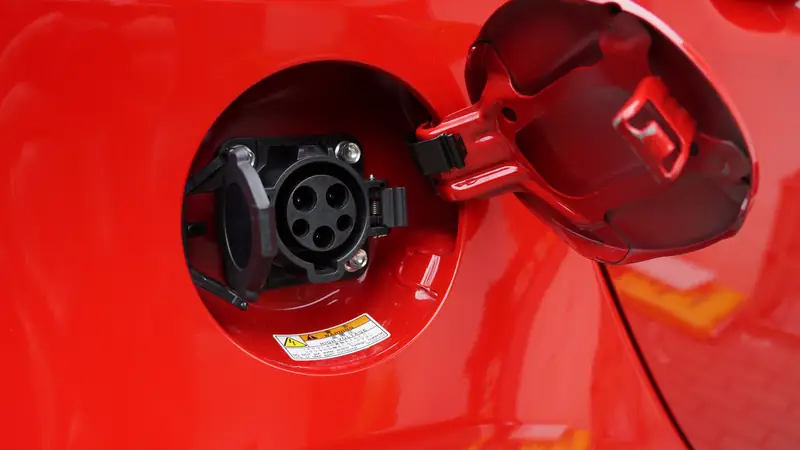
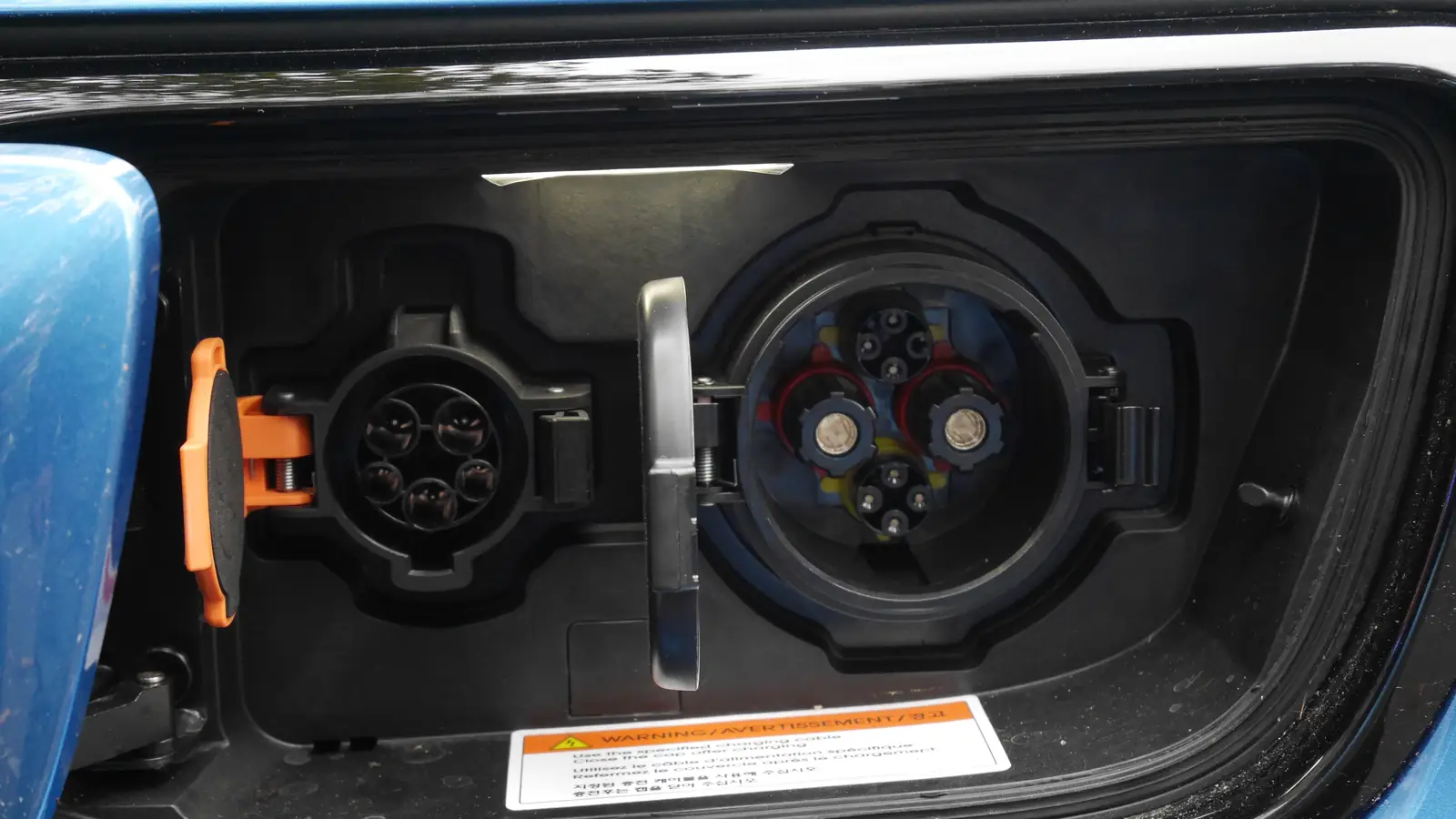
This is the standard plug for Levels 1 and 2 in North America. According to NRCan, any vehicle with this inlet can use any Level 1 or Level 2 charger in Canada and the United States. Teslas, which have their own port, come with a Tesla-to-J1772 adapter. In Gazo's database, 11,666 public chargers have a J1772 plug, or 74% of the total.
CCS1 (Combo): the most common fast-charging plug
The CCS1 connector, also called SAE Combo, adds two DC pins below the J1772 plug. NRCan says most automakers use it, except Tesla. The result: 2,651 of the 2,964 fast chargers mapped by Gazo, or 89%, have a CCS1 plug.
CHAdeMO: the plug on its way out
CHAdeMO is a DC-only plug that NRCan describes as not widely used, except by Nissan and Mitsubishi. Even Nissan is moving on: the 2026 LEAF sold in Canada has a J1772 port for Level 2 and a NACS port for fast charging.
Existing chargers still have plenty of them: 1,878 fast chargers still offer CHAdeMO. The Circuit électrique says it has no plans to remove the CHAdeMO plug from its current stations.
NACS (SAE J3400): Tesla's plug, now the standard
NACS (North American Charging Standard) combines AC and DC charging in one compact connector, the one used at Tesla Superchargers. NRCan says it became available to all automakers in 2022 and is now a preferred connector type for vehicles in Canada. SAE International standardized it as J3400: first issued in December 2023, revised in September 2024.
Gazo maps 1,098 chargers with a NACS plug, mostly Tesla Superchargers and Tesla destination chargers. The Circuit électrique has started adding NACS to its fast chargers (opens in a new tab), starting where there's no Supercharger nearby.
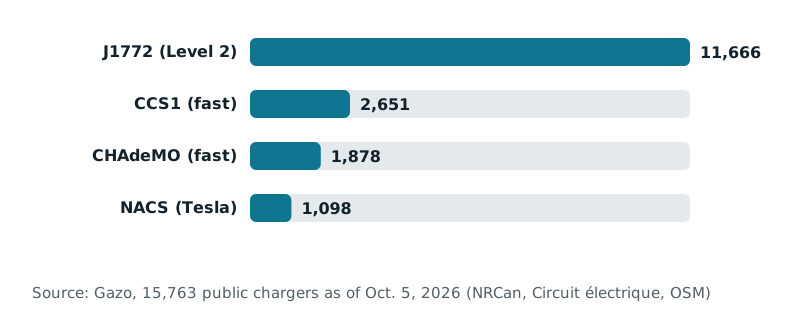
What 15,763 public chargers tell us
As of October 5, 2026, these 15,763 public chargers add up to 42,982 charging ports, since one charger can serve several cars at once. Quebec has 5,570 of them, ahead of Ontario (4,594) and British Columbia (2,734). Close to one in five offers DC fast charging: 2,964 across Canada, including 728 in Ontario and 623 in B.C.
Fast-charger power varies a lot. Here's how the 2,927 fast chargers with a known rating break down by maximum power:
| Maximum power | Fast chargers in Canada |
|---|---|
| 20 to 49 kW | 112 |
| 50 to 99 kW | 1,154 |
| 100 to 149 kW | 618 |
| 150 to 249 kW | 667 |
| 250 kW and up | 376 |
The median is 100 kW. Keep in mind that your car has its own ceiling: Nissan, for example, lists up to 150 kW for the 2026 LEAF. Your vehicle's spec sheet tells you how much you can really draw from a powerful charger.
In Toronto, Gazo counts 634 chargers within 12 km of downtown, 38 of them fast; in Vancouver, 706, including 83 fast chargers. You'll find the full list of EV chargers in Toronto and EV chargers in Vancouver, with their plugs and power. And for 1,015 chargers, the source doesn't say which plug they have: Gazo tells you so instead of guessing.
NACS adapters: what works and what doesn't
An adapter lets one plug fit another, but not every way around, and not at every charger.
- CCS1 car at a Supercharger: GM Canada sells a NACS DC adapter through its dealers that gives Cadillac, Chevrolet and GMC drivers access to more than 17,800 Tesla Superchargers across Canada and the U.S. GM says it does not work with Tesla's Level 2 chargers: it's built for DC fast charging only.
- Tesla at a J1772 charger: the Tesla-to-J1772 adapter comes with the car, according to NRCan.
- Tesla on the Circuit électrique: models built from 2022 on plug straight into the network's NACS chargers, or into the others with a certified adapter. Some 2021 and older models need a retrofit.
- Newer NACS car: the 2026 LEAF needs no adapter at Superchargers, since its fast-charging port is already NACS.
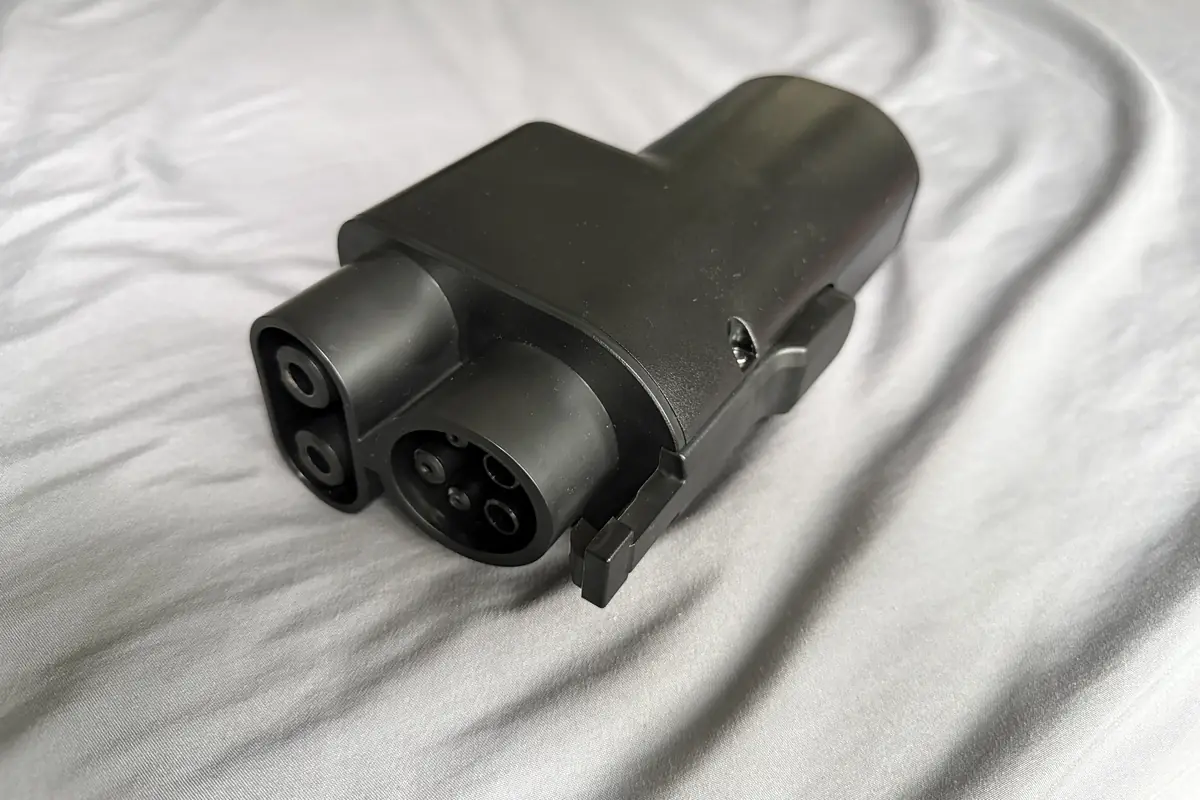
The safe move: use the adapter your automaker recommends and check what your owner's manual says, as GM advises.
Find the right plug with Gazo's Charging mode
The Charging mode in the app uses the same data. You can filter by plug (J1772, CCS, CHAdeMO, NACS), by power (fast only, or above a kW threshold), by network, or show free chargers only. A charger whose source doesn't list its plug is left out by the filter rather than ranked at random. The "Go" button then opens Google Maps, Waze or Apple Maps. As for free charging, we've counted the free EV charging stations in Quebec and across Canada.
Each charger page shows the published rate when the source provides one (the Circuit électrique, for example), prices reported by drivers and an estimated cost; we break down that math in our article on EV charging costs in Canada, and run the full comparison in electric vs gas car cost. Gazo never shows real-time availability, because no open source publishes it. Instead, drivers can report on the spot whether a charger is free, busy, blocked by a gas car or out of order, with the time of the report.
For the bigger picture, see EV chargers in Ontario or the map of all EV chargers in Canada.
Sources
Facts checked against these official or recognized sources.
- Natural Resources Canada, "Electric vehicle charging" (levels, J1772, SAE Combo, CHAdeMO and NACS connectors), page modified July 22, 2026: natural-resources.canada.ca (opens in a new tab) (accessed October 5, 2026)
- Hydro-Québec, "Bornes de recharge pour véhicules électriques, Guide technique d'installation" (technical installation guide), 2nd edition, August 2015, table 1 (Level 1 and 2 power): hydroquebec.com (opens in a new tab) (accessed October 5, 2026)
- SAE International, "J3400_202409: North American Charging System (NACS) for Electric Vehicles," Recommended Practice, issued December 2023, revised September 2024: saemobilus.sae.org (opens in a new tab) (accessed October 5, 2026)
- Circuit électrique, "NACS connectors," November 5, 2025: lecircuitelectrique.com (opens in a new tab) (accessed October 5, 2026)
- Circuit électrique, "Types de bornes" (charger types): lecircuitelectrique.com (opens in a new tab) (accessed October 5, 2026)
- Circuit électrique, "Est-ce que mon véhicule électrique peut être rechargé au moyen d'une borne de recharge rapide ?" (fast-charger compatibility), November 4, 2025: lecircuitelectrique.com (opens in a new tab) (accessed October 5, 2026)
- GM Canada, "EV Charging" (NACS DC adapter, Tesla Supercharger access): gm.ca (opens in a new tab) (accessed October 5, 2026)
- Nissan Canada, "2026 Nissan LEAF Press Kit," June 11, 2025: canada.nissannews.com (opens in a new tab) (accessed October 5, 2026)
- Gazo, public EV chargers mapped as of October 5, 2026 (15,763 active records, duplicates removed), based on NRCan (station locator, AFDC API), the Circuit électrique (Données Québec, CC BY 4.0) and OpenStreetMap (© OpenStreetMap contributors, ODbL); Gazo calculations (internal data)