
Why gas prices change so much from day to day
Gas can jump 10 cents in one evening, then slide back a few cents at a time the next day. Behind the roller coaster: wholesale prices, the seasons and the way stations follow each other. In Atlantic Canada, a regulator sets the price instead.
 By The Gazo team
7 min read

In this article
Saturday, October 3, 10 p.m.: across the Montreal area, the most common price for regular is 194.9¢ a litre. Sunday morning: 204.9¢. Sunday evening: 194.9¢. A quarter past midnight on Monday: 204.9¢ again. So why do gas prices change so much? Part of it is the big picture (wholesale prices, taxes, the seasons) and part is what happens street by street: price cycles between neighbouring stations.
What's in a litre of gas
Quebec's energy regulator, the Régie de l'énergie, splits the pump price into four pieces in its FAQ on fuel prices (opens in a new tab) (in French):
- the rack price, the wholesale price paid at the terminal, which covers crude oil and the refining margin;
- delivery to the station;
- taxes;
- the retail margin, which pays for running the station and the retailer's profit.
On average in Canada, according to the Competition Bureau (opens in a new tab), crude accounts for about 40% of the price, taxes 35%, refining 17% and distribution 9%. Since taxes rarely move, day-to-day swings mostly come from the wholesale price and station margins. For the tax side, province by province, see our guide to gas taxes in Canada and Quebec, and our explainer on why gas is more expensive in Quebec than in Ontario.
The rack price leads the way
According to the Régie, the minimum rack price in Montreal is based on the spot price of gasoline in New York Harbor, and it follows New York more closely than the price of a barrel of crude. A hurricane, a refinery outage or a weaker Canadian dollar, and gas costs more to buy wholesale here too.

Over eight weeks, the Montreal rack price went from 124.9¢ to 153.0¢ a litre (+28.1¢) and the average pump price from 173.5¢ to 199.7¢ (+26.2¢). The gap between the two lines pays for taxes, delivery and the station's margin. It isn't steady: pump prices lag behind, then catch up all at once. Between Wednesday, September 30 and Friday, October 2, the rack price rose 12.3¢ while the average pump price rose only 4.2¢, squeezing station margins. On Saturday night, a wave of increases hit.
Why gas prices change with the seasons and taxes
- Late spring and summer. Refineries shut down for maintenance ahead of peak summer demand, which often pushes wholesale prices up, the Competition Bureau explains. Summer and winter gasoline also use different additives, which slows production, the Régie adds.
- Fall. Demand drops, and wholesale and retail prices generally follow.
- Long weekends. According to Natural Resources Canada, gas doesn't go up before a long weekend any more than before any other weekend.
Taxes rarely change, but when they do, it's overnight. On April 20, 2026, the day the 10¢ federal excise tax was suspended, gas prices dropped 11¢ a litre, according to Finance Canada. The suspension runs to January 31, 2027; the tax comes back at 5¢ in February and March, then 10¢ on April 1, 2027.
Price cycles: up all at once, down a little at a time
Natural Resources Canada describes the mechanism (opens in a new tab). Prices are posted on big roadside signs, so when one station cuts its price, nearby stations match it to avoid losing customers. Cuts can follow cuts until stations are selling at a loss. That can't last: stations then put their prices back up, usually to earlier levels, and the cycle starts over. It looks like everyone raises prices at once, but the increase actually takes some time to spread.
Matching prices aren't illegal on their own: competing stations can charge the same price as long as they haven't agreed to do so, the Competition Bureau points out. Price-fixing (opens in a new tab), on the other hand, is a crime.
A price wave up close in Montreal
Since April 1, 2026, every gas station in Quebec must report its prices to the Régie de l'énergie, which publishes them. It's the only province where you can follow a wave station by station. Here is the one from the first weekend of October, at 727 stations within 40 km of downtown Montreal.
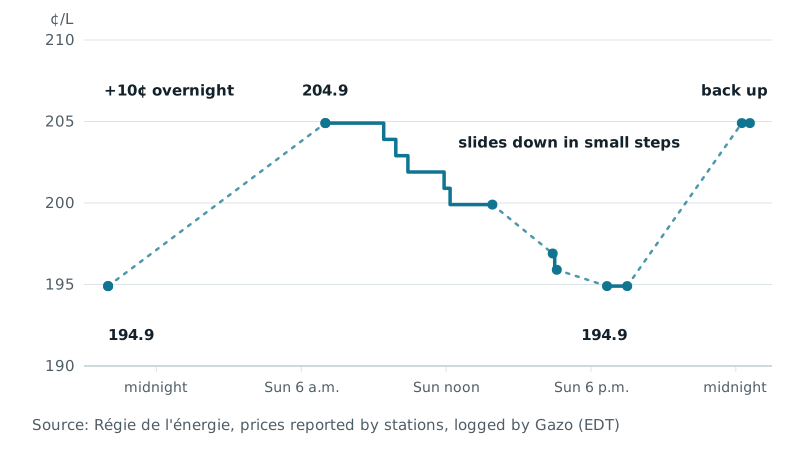
- Saturday night. Before 10 p.m., 17 stations go up by 5¢ or more, 14 of them under the same banner: these are the leaders. Overnight and into Sunday morning, 391 stations follow (median increase: 12¢).
- Sunday. The price war is back on: 515 stations cut prices, usually 1¢ to 3¢ at a time (median drop over the day: 10¢). By 7:30 p.m., the median is back to 194.9¢.
- Overnight into Monday. A second wave, flagged by Gazo at 12:19 a.m.: 341 stations going up, by a median of 10¢.
What time do gas prices change? In Quebec, there's no set time: each station changes its price whenever it wants. That weekend, the increases came in the evening and overnight, and the cuts during the day.
Not everyone moves at once. At 12:40 a.m. on Monday, 26 of the 221 stations within 12 km of downtown Montreal were still under 200¢, five of them at 185.9¢ or less. On a 50-litre fill-up, a 19¢ gap (204.9 − 185.9) is $9.50. For what to do when a wave hits, read our guide to gas prices going up.
That's what Gazo's price-increase banner is for, in Quebec ("Prices are going up in Montreal", for example). When at least four nearby stations go up by 5¢ or more within an hour while most of their neighbours are still at the old price, the app shows the banner along with the stations still at the old price and their "Go" button. With Gazo+, a notification also tells you when prices jump in your alert area. Curious where the data comes from? Read our article on Quebec's official station prices or check gas prices in Montreal.
Regulated gas prices in the Maritimes and Newfoundland and Labrador
In all four Atlantic provinces, a public regulator sets a maximum price, sometimes a minimum too, based on the wholesale price of gasoline in New York plus allowed margins, delivery and taxes. A station can sell below the maximum, never above it. New prices take effect at 12:01 a.m.
| Province | Who sets it | Type of price | When it changes |
|---|---|---|---|
| New Brunswick | Energy and Utilities Board | Maximum, one zone | Fridays at 12:01 a.m. |
| Nova Scotia | Nova Scotia Energy Board | Minimum and maximum, 6 zones | Fridays at 12:01 a.m. |
| Prince Edward Island | IRAC | Minimum and maximum | Tuesdays and Fridays at 12:01 a.m. |
| Newfoundland and Labrador | Public Utilities Board | Maximum, 14 zones | Daily, Tuesday to Saturday, since April 2026 |
The interrupter clause
All four regulators can change prices off schedule when markets jump. In Nova Scotia, the interrupter (opens in a new tab) is typically used when the wholesale price moves at least 6¢ a litre away from the benchmark for more than one day; new prices take effect at 12:01 a.m. the next morning. In Newfoundland and Labrador, the board considers an extraordinary adjustment (opens in a new tab) once the gap reaches 6¢ to 8¢. New Brunswick and PEI publish no trigger. So a price change on a Wednesday in Moncton isn't a calendar mix-up.
Prices as of October 2, 2026 and what Gazo shows
Self-serve regular, since Friday, October 2: a 195.2¢ maximum in New Brunswick, 191.7¢ to 194.6¢ in the Halifax zone, 202.9¢ to 204.0¢ in PEI. In Newfoundland and Labrador, the Avalon zone maximum was 224.4¢ on Saturday, October 3.
Comparing still pays, especially where there's a range. In Gazo, an Atlantic station with no recent reported price shows an estimate, clearly labelled as one and never ranked with reported prices: its zone's regulated maximum in New Brunswick, Nova Scotia and PEI, and Natural Resources Canada's average for the nearest city in Newfoundland and Labrador. See these benchmarks for Halifax, Charlottetown, St. John's and New Brunswick.
Sources
Facts checked against these official or recognized sources.
- Régie de l'énergie, "Foire aux questions : Le prix de l'essence, du diesel et du mazout léger" (in French): regie-energie.qc.ca (opens in a new tab) (accessed October 5, 2026)
- Régie de l'énergie, "La Régie de l'énergie lance une plateforme interactive pour suivre les prix de l'essence partout au Québec" (in French): regie-energie.qc.ca (opens in a new tab) (accessed October 5, 2026)
- Régie de l'énergie, prices reported by stations (regieessencequebec.ca), logged by Gazo from October 3 to 5, 2026: 727 stations within 40 km of downtown Montreal; 221 stations within 12 km of downtown Montreal on October 5 at 12:40 a.m.
- Natural Resources Canada, "Why gasoline prices go up and down?": natural-resources.canada.ca (opens in a new tab) (accessed October 5, 2026)
- Natural Resources Canada, "Daily Average Retail Prices for Regular Gasoline in 2026" and "Daily Average Wholesale (Rack) Prices for Regular Gasoline", Montreal, August 7 to October 2, 2026: www2.nrcan-rncan.gc.ca (opens in a new tab) and www2.nrcan-rncan.gc.ca (opens in a new tab) (accessed October 5, 2026)
- Competition Bureau, "Gasoline prices: Illegal activity versus normal competition — Understanding the gasoline industry": competition-bureau.canada.ca (opens in a new tab) (accessed October 5, 2026)
- Competition Bureau, "Gasoline prices: Illegal activity versus normal competition — What is and isn't price-fixing": competition-bureau.canada.ca (opens in a new tab) (accessed October 5, 2026)
- Department of Finance Canada, "The Government of Canada extends the federal fuel excise tax relief on gasoline, diesel, and aviation fuels for Canadians", September 2, 2026: canada.ca (opens in a new tab) (accessed October 5, 2026)
- New Brunswick Energy and Utilities Board, "Petroleum Products" and maximum prices in effect October 2, 2026: nbeub.ca (opens in a new tab) and nbeub.ca (opens in a new tab) (accessed October 5, 2026)
- Nova Scotia Energy Board, "Gasoline & Diesel Prices & Zone Map", FAQs and "The Interrupter": nserbt.ca (opens in a new tab), nserbt.ca (opens in a new tab) and nserbt.ca (opens in a new tab) (accessed October 5, 2026)
- Island Regulatory and Appeals Commission, "Petroleum" and "Current Petroleum Prices": irac.pe.ca (opens in a new tab) and irac.pe.ca (opens in a new tab) (accessed October 5, 2026)
- Board of Commissioners of Public Utilities (NL), home page, "Extraordinary Adjustments", "Weekly Adjustments" and "Zones": pub.nl.ca (opens in a new tab), pub.nl.ca (opens in a new tab), pub.nl.ca (opens in a new tab) and pub.nl.ca (opens in a new tab) (accessed October 5, 2026)